Enter a keyword below to search for articles and products.


Watch as Expert Dog Trainer Kathy Santo talks about how to crate train your puppy. She’ll go over everything from the philosophy behind the crate training method to precautions you should take to make sure that it’s a positive experience for the both of you.
Hi, I'm Kathy Santo with IAMS, and today we're going to talk about how to crate train your puppy. We'll begin with a general discussion on the philosophy supporting the crate training method. We'll review what you'll need, the steps involved in the process itself, and some possible troubles you may encounter along the way. Before you begin crate training, it helps to understand the philosophy behind this method. If your dog is properly crate trained, he'll view his crate as a private room with a view, a safe haven he can call his own, and a quiet place he can relax in. He won't see it as a rigid structure of confinement and punishment. In fact, it'll be just the opposite. In nature, wild dogs seek out and use their den as a home where they can hide from danger, sleep, and raise their young. In your home, the crate becomes your puppy's den, an ideal spot to sleep and stay out of harm's way. And for you, the benefits of crate training are house training, because your puppy won't like to soil the area where he sleeps, limited access to the rest of the house, where he learns the house rules, and transporting safely and easily in the car. Start crate training a few days after your puppy settles in. Before you can start crate training, you and your family members must understand that the create can never be used for punishment. Never leave your young puppy under six months in his crate for more than three hours. He'll get bored, have to go to the bathroom, and won't understand why he's been left alone in discomfort. As your dog gets older, he can be crated for longer periods of time, because his bladder isn't as small. But keep in mind he still needs a healthy portion of exercise and attention daily. If you and your family are unable to accommodate your puppy's exercise, feeding, and bathroom needs, consider hiring a dog walker or asking a neighbor or friend for assistance. After that, the crate should be a place he goes into voluntarily, with the door always open. There are a variety of crates available for purchase these days, each of which is designed for a different lifestyle need. When selecting a crate, you want to make sure it's just large enough for your puppy to be able to stand up, turn around, and lay down in comfortably. Because your puppy will grow quickly, I often recommend getting a crate that fits the size you expect your puppy to grow to, and simply block off the excess crate space, so your dog can't eliminate at one end and retreat to the other. The two most important things to remember while crate training are that it should be associated with something pleasant, and takes place in a series of small steps. The first step is to introduce your puppy to his crate. This will serve as his new den. Put bedding and chew toys in his crate, and let him investigate his area. If he chews or urinates on his bedding, permanently remove it. Observe and interact with your puppy while he's acclimating to his crate. This will help forge a sense of pack, and establish you as the pack leader. Encourage him to enter the crate with soft words and some treats. You can also pre-place some treats in the back corners and under the blankets to help make it a pleasant experience. Step two is to start feeding your puppy in his crate. Begin with the bowls near the opening of the crate. As your puppy becomes less reluctant to enter, slowly inch the food back every feeding, until you're placing it all the way in the back. When you get to the point where your puppy happily enters the crate, and stands in the back to eat, begin gently closing the crate door behind him while he's eating. At first, open the door immediately after he finishes. But after that, begin leaving the door closed a bit longer every time. If your puppy cries, you may have increased the time too fast. So decrease the length of it, and then slowly begin increasing it again. When he does cry, do not let him out until he stops, or he'll always do this to get his way. Once your puppy is used to eating his meals and waiting to be let out with no anxiety or crying, you can start confining him longer when you're home. To do so, call him over with a treat, and give it to him in his crate. Associating a command such as 'kennel' is important, so he understands the reward is a result of going in the crate. At first, you'll need to sit quietly next to him. If he's fine after 10 minutes, go into the other room for a bit, and then come back and let him out, only if he is calm and not crying. If he is crying, you'll have to wait until he's calm. Once you can leave him for about 30 minutes at a time without him getting upset, you can start leaving him there longer. Eventually, decrease the amount of reward you give him for entering the crate, so that saying the command word is sufficient. When you get home after being away for a long time, your puppy will likely be very excited to see you. It's important not to reward this behavior, or anticipating your arrival every day may be stressful for him. And lastly, make sure to crate your dog for short periods of time while you're home, or else he will associate crating with being left alone. I'm Kathy Santo with IAMS, and I hope that you found this helpful as you welcome your new addition to your family.


Having a puppy in your household never lets a dull day knock on your door. What could be more exciting than having a fur baby live with you? For some of you, it may also be a lifelong dream finally coming true. While everything about sharing your space with a pup sounds delightful, it starts going south when an untrained puppy takes over the house.
Procrastinating the process of house training a puppy can drive your pooch to eliminate in your house and ruin carpets and furniture. This is not a pretty scenario in the long run because not being able to control your little pup can put you and your family into distress. And most first-time pet parents are clueless regarding how to handle and control their furry companion. If you are one of them, here’s everything you need to do to house train your puppy.
This is not something that you take lightly. You need to be determined and consistent with the process if you want this to stay with your pup forever. House training a dog requires patience and perseverance. Create a puppy house training schedule and stick to it. Try to get your puppy used to walking on leash before you start potty training.
Note: You need to know that your dog is new to your house, it will need time to adjust in the brand-new environment. So, make sure that you do not develop a plan that is too overwhelming for your pet.
A routine always helps in the long run, whether it is for us or for our dogs, establishing a routine will help your dog to understand that there is a specific time to eat, play, sleep, or potty. So, with this, your dog will know that there is a particular time to poop as well. It is better to have a dog with a routine than the one who defecates anytime, anywhere.
Taking your puppy out at appropriate times is non-negotiable. Take it out for a walk right after it wakes up, during its play time, and after it eats or drinks because these are the times when dogs are most likely to want to go. Hence, keep a good gap between meals and water, and bedtime, so your pup does not have to hold their business in for too long.
As a dog parent, you must know that for every month of age, puppies can control its bladder for an hour! So, if your pup is 2 months old, it can hold its bladder for 2 hours. However, 6 hours is the limit. Dogs cannot control their bladder for more than 6 hours.
Commands can help pet parents in communicating with their pooch. If you use a command repeatedly for a certain action, your dog will begin to pick up on the relation between your words and the act. For example, if you keep using the phrase ‘go fetch’ while you throw a toy or a stick, your pet will start understanding that it needs to go and retrieve the object. Similarly, when you take your dog out on a leash and want them to defecate, use the phrase ‘go potty’ and point to a particular spot. This will help them realise that they need to go.
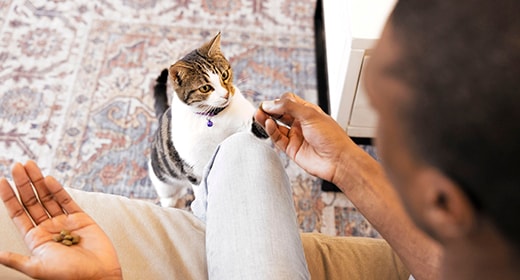
Rewards can help establish a healthy relationship between you and your four-legged friend. These rewards can be in the form of treats or playtime with its favourite toy. It will help you teach new commands while also encouraging good behaviour. Make sure you are not showering treats on your pup before the task or action is complete. For example, give your pooch a treat after it has finished its potty round and not when it is in middle of it. Wondering why? Because then, your pup might not finish what it’s doing and have an accident later inside the house.
Note: If you feel that there's little to no progress, consult your veterinarian to rule out medical issues like bladder infections.
Now that you know how to house train a dog, you must understand that it is a time-consuming process. Your pup might take time to learn, however, with consistent practice, your dog will be obedient. Here are a few things you must know before you two get down to training: