Enter a keyword below to search for articles and products.
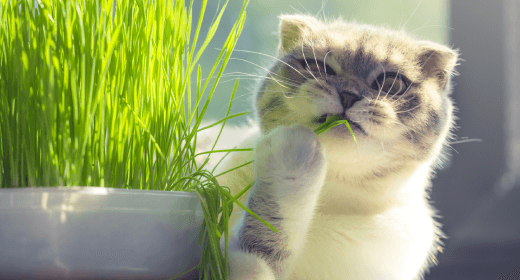
A cat’s diet largely includes other smaller animals as they are carnivorous. However, most cats avoid consuming the animal’s intestinal tract which contains most fibre. This can lead to a lack of fibre in the cat’s diet. But do cats need fibre? Yes. Lack of fibre can result in irregular bowel movement, digestive issues, and other similar health concerns.
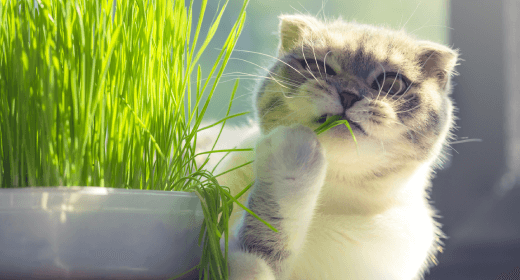
Cats often munch on green grass and leaves to ease constipation. However, they might resist including fibre in their daily meal and only rely on it when ill. But, to ensure your cat’s best physical well-being, you should choose fibre-rich food for cats.
Fibre-rich cat food is essential as it helps in maintaining their digestive health. Thus, pet parents should try to include the necessary amount of fibre in their kitty’s diet. It will help maintain their digestive health and overall well-being. Cat food fibre can be classified based on its solubility.
While choosing cat food with fibre, you should make sure it includes both soluble and insoluble fibre. Besides, the cat’s gut bacteria can break down both soluble and insoluble fibre to produce new compound that helps in nourishing their colon cells.
Fibre-rich cat food contains prebiotics, which means they also contain good bacteria that are necessary for a healthy intestine. So, as a cat parent, you should invest in high-quality cat food with fibre to keep your little fur baby’s gut health in check. However, how much fibre does a cat require??
Although fibre is essential for cats, they require it in limited quantities. Too much fibre can risk restricting absorption of nutrients in their body, whereas too little can lead to poor digestive health. The appropriate quantity of fibre for cats is between 1.4 to 3.5% of their daily calorie intake.
Planning to include cat food with fibre in your kitty’s daily diet? Consider adding the following food options to their meal to increase fibre content in your fur baby’s diet.
Besides relying on the above-mentioned plant-based and animal-based fibre, you can also buy IAMS high-fibre cat food to ensure that your kitty gets the right amount of fibre in its meal. IAMS high-fibre cat food such as IAMS ProActive Health Adult Original with Chicken contains a moderate quantity of fermentable fibre along with the chicken. This cat food with fibre is made using fermentable fibre and chicken that your cat is sure to relish. Besides, IAMS is a popular cat food brand that is known for using best-quality ingredients, so your furry friend gets nothing but the best.
You can easily add fibre into your cat’s diet by choosing a cat food brand that offers fibre-rich cat food or by adding animal-based or plant-based fibre to their daily meal.
Yes, cats need fibre for better gut and intestinal health. However, a cat’s fibre intake should not be more than 3.5% of its daily calorie diet.
Dry food often has more fibre as it contains more bulk compared to wet food which contains more moisture.
Yes, all cats need fibre for better digestion and gastrointestinal health.
Plant-based fibre such as broccoli, lettuce, carrots, wheat brans, spinach, wheatgrass, and green beans are good for cats. You can also add animal-based fibre such as animal feathers, cartilage, bone, and ligaments to your cat’s diet for encouraging fibre consumption.
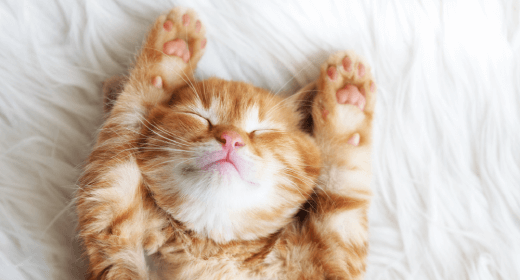
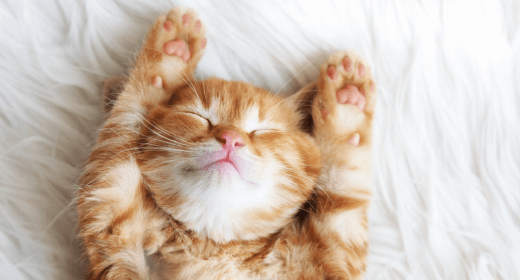
Kittens are curious, energetic fluffballs with boundless energy. A safe, enriching environment can cater to your kitten’s playful side, stimulate them physically and mentally, and benefit their health and development for the rest of their life.
Keeping your kitten indoors has significant benefits because it protects them from a large number of dangers. But without all the sights, sounds and smells of nature, a kitten needs other ways to stimulate their mind and body.
To build your kitten an enriching environment, provide them with safe places for hiding and resting, like window ledges, carriers or perches. Your kitten should feel protected in their safe spots and may prefer an enclosed resting area. While kittens spend a great deal of their time sleeping, their periods of wakefulness can and should be used to stimulate psychological and physical activity.
It’s important to create stimulating places for entertainment and play, as well. Cats can benefit from spaces at different vertical levels, like cat trees and perches. A variety of scratching posts can teach your kitten appropriate scratching while nurturing their natural instincts, and protect your furniture and carpet from their sharp claws.
Many cats also benefit from social activity with other cats, especially if they were introduced to other cats early in life. Providing your kitten with another kitten or young cat as a play buddy can help meet their need for near-constant play and motion. Keep in mind that cats put a premium on managing space, so it’s important that multiple-cat homes offer a variety of places to hide, sleep and observe, using both the horizontal and vertical dimensions.
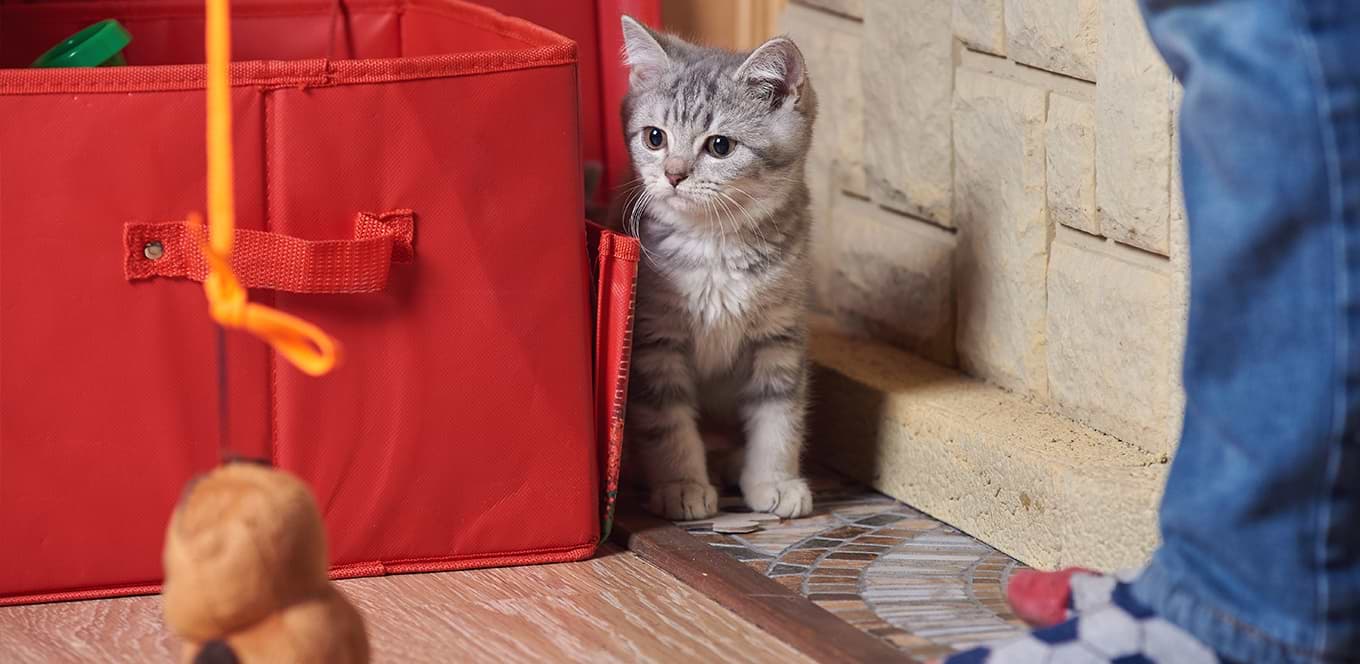
An important component to enriching your kitten’s environment is socialization and play, especially if your kitten is the only animal in the household. A kitten’s natural predator-play behavior is usually easy to stimulate with interactive toys, such as wand toys or balls to pounce on or chase.
Playing kitten games with your pet helps them develop coordination and natural hunting skills. It also can help them learn boundaries and develop a bond with their new owner. Aim for 10 to 15 minutes of structured playtime two or three times a day. One way to prevent the “nighttime crazies” is to engage in active, vigorous play before feeding your kitten at bedtime. This helps wear out the kitten before bed and mimics the natural hunting-feeding-grooming-sleeping sequence in cats.
Engaging games to play with your kitten include:
An important component to enriching your kitten’s environment is socialization and play, especially if your kitten is the only animal in the household. A kitten’s natural predator-play behavior is usually easy to stimulate with interactive toys, such as wand toys or balls to pounce on or chase.
A greater challenge is providing enrichment opportunities for kittens when a person or another pet is not present to interact with them. Puzzle toys are one option to fight kitten boredom. These toys come in a variety of designs to entertain your kitten and reward her with a treat or food, such as IAMS™ ProActive Health™ Healthy Kitten with Chicken. This offers twofold benefits, providing play and proper nutrition for supporting a kitten’s energy and playtime.
Kittens and cats will spend a great deal of time watching the outside world through windows, especially if there’s a bird feeder or butterfly garden within view. Make sure to keep at least one window blind open — especially if it looks out on an area with frequent movement and activity. There are also a number of “cat TV” videos of squirrels, birds and other nature scenes available online to keep a cat entertained.
Providing your kitten with enrichment opportunities helps prevent stress and the development of abnormal behaviors. Growing from a kitten into a cat in an enriched environment with lots of physical and psychological exercise supports the overall well-being of your pet at all stages of her life.