Enter a keyword below to search for articles and products.
The Association of American Feed Control Officials (AAFCO) was formed in 1909 to establish a framework for uniform regulation of the feed industry. Although not a government agency, AAFCO operates within the guidelines of federal and state legislation including laws administered by the Food and Drug Administration (FDA) and the U.S. Department of Agriculture (USDA).
AAFCO establishes standards or models for regulations aimed at ensuring that manufacturers provide clear, accurate, and consistent information about animal feed, including pet food.
Every year AAFCO issues an official publication called the AAFCO Manual. This manual, in addition to listing ingredient definitions and feed terms, addresses labeling issues such as label format, ingredient lists, nutrition claims, and guaranteed analysis.
These model regulations are different than laws. However a large number of state governments have adopted AAFCO pet food model regulations into state law.
The “AAFCO statement of nutritional adequacy or purpose,” also called a “nutrition claim” or “complete and balanced statement,” identifies which life stage and/or lifestyle the product has been approved for. Under AAFCO regulations, this statement must be substantiated by the manufacturer.
AAFCO recognizes three methods for substantiating the claim:
AAFCO has outlined very specific protocols, or guidelines, for conducting feeding tests. The protocols specify test criteria including such things as:
Each life stage has its own protocol. Life stages are the same for both dogs and cats and are defined as:
A pet food with an 'All Life Stages' claim can be used from weaning through adulthood. This claim is considered an unqualified (absolute) representation of nutritional adequacy. If substantiated through feeding trials, the protocol for gestation/lactation and growth must be performed sequentially, using the same group of animals.
AAFCO regulations state that specific wording must be used when a diet is intended for special nutritional or dietary needs that require the involvement of a veterinarian for diagnosis, management, and follow-up.
Understanding the AAFCO statements for nutritional adequacy can help customers choose a high-quality diet that provides complete and balanced nutrition for the appropriate life stage of their dog or cat.
Potty training your cat at an early age can help inculcate essential hygiene habits. Starting kitten litter training as soon as your newborn pet hits the four-week mark ensures that it is well aware of its surroundings. Moreover, it ascertains that your kitty does not dirty the home. For all new cat parents wondering how to potty train a kitten, here are a few tips to get you started. Read on to learn more about the right age to start training your kitten, how to pick the right size of a litter box and more.
Adult cats naturally seek out sandy places to defecate but kittens need some guidance. Fortunately, you do not have to worry much about how to teach your kitten to use a litter box because it comes naturally to kittens. If you are a first-time cat parent, here’s a fact that will put you at ease: unlike puppies, potty-training kittens can be fairly easy. Moreover, it is one of the first exercises you will do as a caregiver.
Things learnt at an early age, generally, stick with you for time immemorial. And that holds true in cats as well. Hence, you can start potty training kittens once they turn 4 weeks old. If you are adopting a kitten that’s older than 4 weeks or an adult cat, start potty training it immediately.
Potty training is an important part of adopting a cat, especially if you do not want to clean the house zillion times a day. However, it is not like you buy a litter box and your kitty will get the hint. You need to teach your pet to do its business in the box. And as a first-time cat parent, you might be clueless about how to potty train a kitten. Fret not, we have got you covered. Here are a few tips to help you get started with kitten litter training:
The first step to kitten litter training is choosing a litter box. Since you are picking out a litter box for your kitten, it can be small and compact in size. Make sure there is enough room for your kitty to go in that box. It should be easy to enter and not too compact for your kitten’s size.
Moreover, your cat might feel uncomfortable defecating in certain types of boxes. Some cats might like keeping their business private, while some could prefer being aware of their surroundings. Hence, finding the right litter for your kitten may involve some testing.
Choosing the right spot for the litter box is imperative. Place it somewhere that is not too loud, but also ensure that the box is within human interaction. For example, if you place the litter box in your basement, your kitten may not feel comfortable and eliminate somewhere in the house. You can also place the litter box in the bathroom. If you have multiple floors in your house, place at least one easily accessible litter box on every floor. Moreover, make sure you do not place the litter box next to your cat’s food and water bowls.
Once you have placed all your litter boxes at desired locations, it is time to start potty training your kitten. Assuming that you have placed multiple litters in your house, take your kitty to each box and let it sniff them. Next, place your kitten in the litter box. It may start pawing the litter or even use it right away. If it doesn’t, run your fingers through the litter to demonstrate pawing actions.
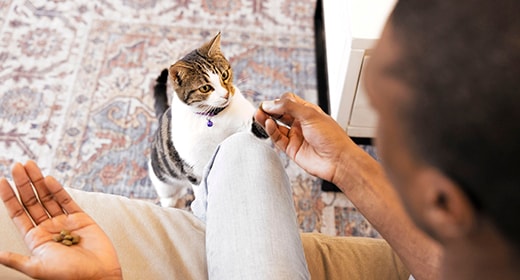
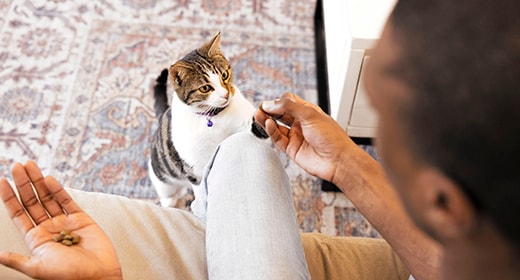
Here’s a tip on how to train a kitten to use a litter box: reward it. Shower your purrfect pal with its favourite treat whenever it uses the litter box successfully. For this to work, you need to give your cat a treat right after it uses the litter box so that it starts associating the usage of the litter box with good behaviour.
Keeping the litter box clean is crucial to ensure that your kitten does not develop an aversion to the box. You can scoop out your cat’s waste after each use. Keep adding some litter every time you are scooping out waste to make sure that the litter depth is maintained and your kitten can easily dig. Once your cat is a little older and used to the box, you can start cleaning it once a day.