Enter a keyword below to search for articles and products.
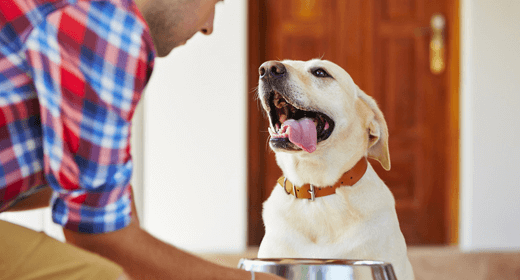
No two dogs are alike. So when choosing your pet's food, you'll want to take into consideration the dog's breed, size, age, weight, and lifestyle.
Full growth will happen at around 1 to 2 years, with the exact age determined by your dog's breed—small-breed dogs mature faster than large-breed dogs. “Grown dogs, especially ones who are more athletic, will start to eat more quantities in one feeding,” says Madan Khare, DVM. “You want to limit his feeding to one or two times a day, depending on his activity level.” Exact quantities should be determined by consulting your vet or by reading the package labels (just remember to split a daily serving). Mature dogs are prone to obesity, so it is necessary to feed them carefully. in half if you choose to feed the dog twice a day.
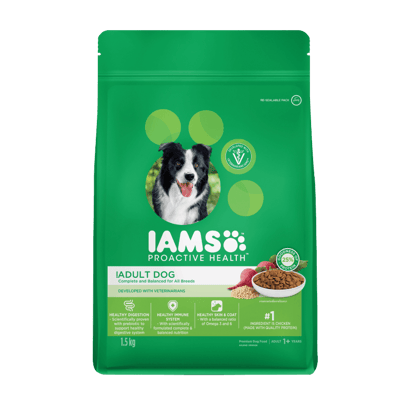
When transitioning your dog from puppy food to premium adult food—such as IAMS™ ProActive Health™ Adult Dog Food —you want to do it gradually. “Never change a dog's diet abruptly,” Khare says. Here's a schedule for transitioning your pet from puppy food to an adult dog food.
Day 1: Fill your dog's bowl with 75% puppy food and 25% premium adult dog food.
Day 2: Use 50% of each food.
Day 3: Feed your dog a mixture of 75% premium adult food and 25% of your current dog food.
Day 4: Give him 100% premium adult dog food.
Daily exercise and a diet packed with high-quality protein from chicken, lamb, or fish and essential nutrients will keep him happy and healthy throughout his lifetime. Premium dry pet food has all of the daily nutrition your pet needs. It helps promote healthy teeth and gums, too.
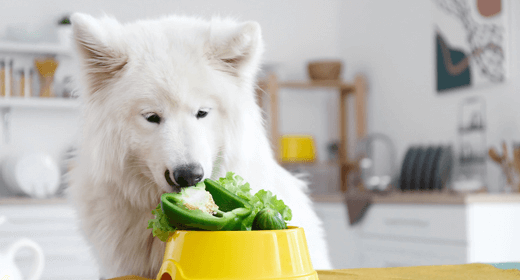
“When it comes to feeding your dog human food, I have three words,” Khare says. “No. No. No.” Interfering with your pet's food regimen by adding higher-fat and higher-calorie human foods can disturb the animal's digestive system. When it comes to biscuits, Khare recommends looking for ones low in sugar, salt, and fat. 'You have to keep in mind that you're adding calories to his daily diet, so offer them in moderation,” Khare says. Finally, make sure your pet has a clean bowl of fresh water at all times.
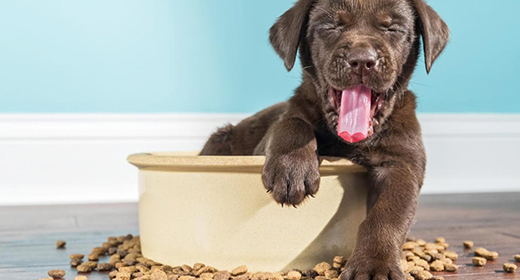
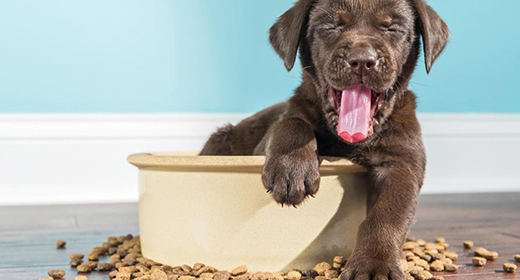
How much do you know about the food you’re buying for your puppy? When shopping for puppy food, pay attention to these three sections of a dog food label.
This section lists all the ingredients that make up the product. The ingredients are listed in descending order according to weight before cooking. In dry food, look for a source of high-quality animal-based protein: chicken or lamb, for example. Dogs thrive on animal proteins.
Manufacturers who use large amounts of vegetable proteins might be saving money by providing basic — but not optimal — nutrition. You should also avoid artificial colors and flavors, which offer no nutritional benefits.
Near the ingredient panel should be a chart of percentages called the 'guaranteed analysis.' These figures reveal the basic nutrient makeup of the dog food's formula and protein content. The minimum percentages of protein and fat and the maximum percentages of fiber and moisture (water) should be listed.
This information must be included on the label by law. A toll-free number or web address for the manufacturer may also be listed. Manufacturers who list a phone number, such as IAMS™, generally have a high-quality product and welcome consumer calls and questions. If you would like information about IAMS products, visit our website or call us toll-free at 800-525-4267.