Enter a keyword below to search for articles and products.
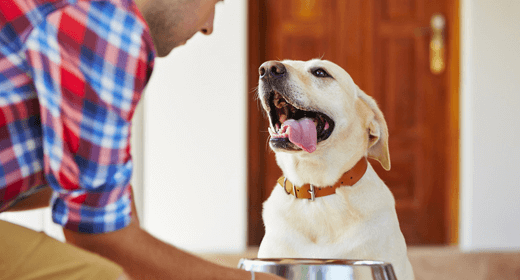
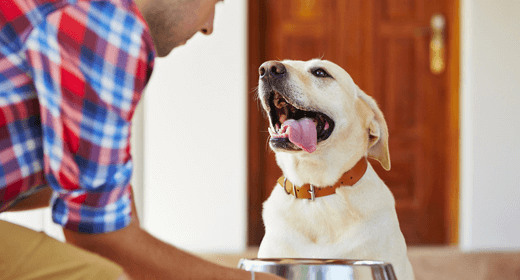
No two dogs are alike. So when choosing your pet's food, you'll want to take into consideration the dog's breed, size, age, weight, and lifestyle.
Full growth will happen at around 1 to 2 years, with the exact age determined by your dog's breed—small-breed dogs mature faster than large-breed dogs. “Grown dogs, especially ones who are more athletic, will start to eat more quantities in one feeding,” says Madan Khare, DVM. “You want to limit his feeding to one or two times a day, depending on his activity level.” Exact quantities should be determined by consulting your vet or by reading the package labels (just remember to split a daily serving). Mature dogs are prone to obesity, so it is necessary to feed them carefully. in half if you choose to feed the dog twice a day.
When transitioning your dog from puppy food to premium adult food—such as IAMS™ ProActive Health™ Adult Dog Food —you want to do it gradually. “Never change a dog's diet abruptly,” Khare says. Here's a schedule for transitioning your pet from puppy food to an adult dog food.
Day 1: Fill your dog's bowl with 75% puppy food and 25% premium adult dog food.
Day 2: Use 50% of each food.
Day 3: Feed your dog a mixture of 75% premium adult food and 25% of your current dog food.
Day 4: Give him 100% premium adult dog food.
Daily exercise and a diet packed with high-quality protein from chicken, lamb, or fish and essential nutrients will keep him happy and healthy throughout his lifetime. Premium dry pet food has all of the daily nutrition your pet needs. It helps promote healthy teeth and gums, too.
“When it comes to feeding your dog human food, I have three words,” Khare says. “No. No. No.” Interfering with your pet's food regimen by adding higher-fat and higher-calorie human foods can disturb the animal's digestive system. When it comes to biscuits, Khare recommends looking for ones low in sugar, salt, and fat. 'You have to keep in mind that you're adding calories to his daily diet, so offer them in moderation,” Khare says. Finally, make sure your pet has a clean bowl of fresh water at all times.
Diet plays a central role in your dog’s overall health and well-being, and it stands to reason that you want to provide your dog the best possible source of nutrition in the dog food you choose. But some nutrients, like L-Carnitine, may be unfamiliar or completely foreign. Learn more about this vitamin-like compound and how it can help your dog maintain a healthy weight.
Carnitine, or L-carnitine, is a vitamin-like compound made in the body from amino acids. It's found naturally only in animal-based protein sources. It has been used to help with fat metabolism in other species, and recent scientific studies show that it can help reduce weight in overweight dogs.
This water-soluble substance attaches to fatty acids, transporting them into cellular mitochondria, the part of the cell that converts fat into a usable form of energy. There, they are broken down through oxidation and converted to energy for all tissues, including the heart, liver, and skeletal muscles. Through this process, carnitine helps reduce the storage of body fat and the amount of fat in the bloodstream.
In a study conducted by The IAMS™ Company, overweight dogs were fed similar diets. One group was given a diet supplemented with L-carnitine while another group received a diet without supplemental L-carnitine.
After seven weeks, the group that received the diet without supplemental L-carnitine lost 1.8% body weight compared to 6.4% body weight loss from the group that was fed the L-carnitine supplemented diet. Likewise, body fat was reduced in each group by 2.4% and 4.6%, respectively.1 The study found that L-carnitine promotes loss of body weight and body fat in overweight dogs.
IAMS™ ProActive Health™ Adult Healthy Weight is formulated with L-carnitine that helps turn fat into energy, providing a path to help keep him fit for life.
1 Sunvold GD, Tetrick MA, Davenport GM, Bouchard GF. 'Carnitine supplementation promotes weight loss and decreased adiposity in the canine.' Proceedings of the XXIII World Small Animal Veterinary Association. p. 746. October, 1998.