Enter a keyword below to search for articles and products.
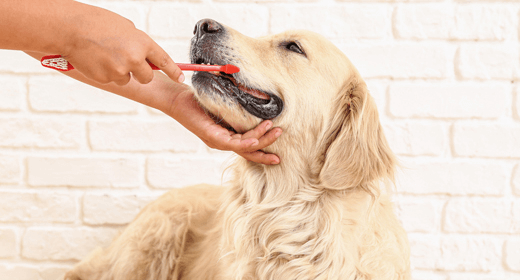
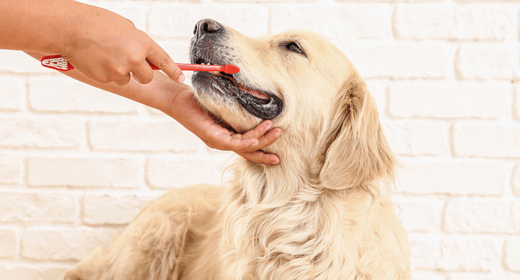
Oral care is a key component of your pet’s overall health: A smart regimen can help prevent the development of serious conditions. Keeping your pet’s teeth clean and bacteria-free results in more than just healthy teeth and fresh breath. With a little know-how and effort, you can protect your pet for a lifetime of companionship.
Tartar and gingivitis are the most common problems seen by veterinarians. The majority of dogs will develop these problems. Unchecked, these can lead to periodontitis and serious health concerns for your pet, up to and including, tooth loss and serious illness. But you can take action to control this and promote good oral health by incorporating the 3Ds: Daily Brushing, Dentistry. and Diet.
Daily brushing of your pet’s teeth will remove plaque and slow the development of tartar. When first beginning to brush, be gradual and make it a pleasant experience. Start by using your finger. Later, introduce a toothbrush. Be sure to praise and reassure your pet while brushing. Also, reward your pet afterward with play or a walk.
Talk with your veterinarian about annual or semiannual teeth cleaning—a dental prophylaxis or prophy for short. Teeth cleaning, performed by your veterinarian, is the only way to remove tartar.
Diet is important to good oral health. The mechanical, brushing action of dry, crunchy kibbles helps remove plaque and works to scrub teeth clean. Some diets also might include ingredients such as hexametaphosphate (HMP) that can help block tartar formation. Diet, daily brushing, and dentistry helps break the plaque-to- tartar cycle and optimize oral health.
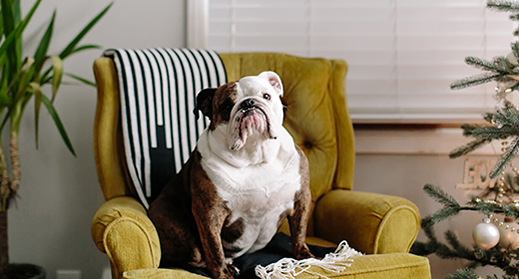
Diet plays a central role in your dog’s overall health and well-being, and it stands to reason that you want to provide your dog the best possible source of nutrition in the dog food you choose. But some nutrients, like L-Carnitine, may be unfamiliar or completely foreign. Learn more about this vitamin-like compound and how it can help your dog maintain a healthy weight.
Carnitine, or L-carnitine, is a vitamin-like compound made in the body from amino acids. It's found naturally only in animal-based protein sources. It has been used to help with fat metabolism in other species, and recent scientific studies show that it can help reduce weight in overweight dogs.
This water-soluble substance attaches to fatty acids, transporting them into cellular mitochondria, the part of the cell that converts fat into a usable form of energy. There, they are broken down through oxidation and converted to energy for all tissues, including the heart, liver, and skeletal muscles. Through this process, carnitine helps reduce the storage of body fat and the amount of fat in the bloodstream.
In a study conducted by The IAMS™ Company, overweight dogs were fed similar diets. One group was given a diet supplemented with L-carnitine while another group received a diet without supplemental L-carnitine.
After seven weeks, the group that received the diet without supplemental L-carnitine lost 1.8% body weight compared to 6.4% body weight loss from the group that was fed the L-carnitine supplemented diet. Likewise, body fat was reduced in each group by 2.4% and 4.6%, respectively.1 The study found that L-carnitine promotes loss of body weight and body fat in overweight dogs.
IAMS™ ProActive Health™ Adult Healthy Weight is formulated with L-carnitine that helps turn fat into energy, providing a path to help keep him fit for life.
1 Sunvold GD, Tetrick MA, Davenport GM, Bouchard GF. 'Carnitine supplementation promotes weight loss and decreased adiposity in the canine.' Proceedings of the XXIII World Small Animal Veterinary Association. p. 746. October, 1998.